MCC Code Classification
Last updated: July 9, 2025
Overview
This check analyzes your business's online presence, products, and services to determine the most accurate Merchant Category Code (MCC) for industry classification and risk assessment purposes.
This check analyzes business information from web presence data and verification sources as part of your KYB (Know Your Business) due diligence process. This check helps you accurately classify merchants according to standard industry codes, supporting your AML and compliance requirements while ensuring proper risk categorization for payment processing and regulatory reporting.
What This Check Does
This check analyzes comprehensive business data to verify:
MCC Code Determination: Automatically assigns the most appropriate 4-digit MCC code based on business activities
High-Risk Industry Identification: Flags businesses in high-risk merchant categories requiring enhanced monitoring
Business Classification Validation: Validates self-attested MCC codes against actual business operations
Alternative MCC Recommendations: Provides alternative MCC options when primary classification is uncertain
Regulatory Compliance Alignment: Ensures MCC assignments support AML/KYC compliance requirements
How to Add This Check
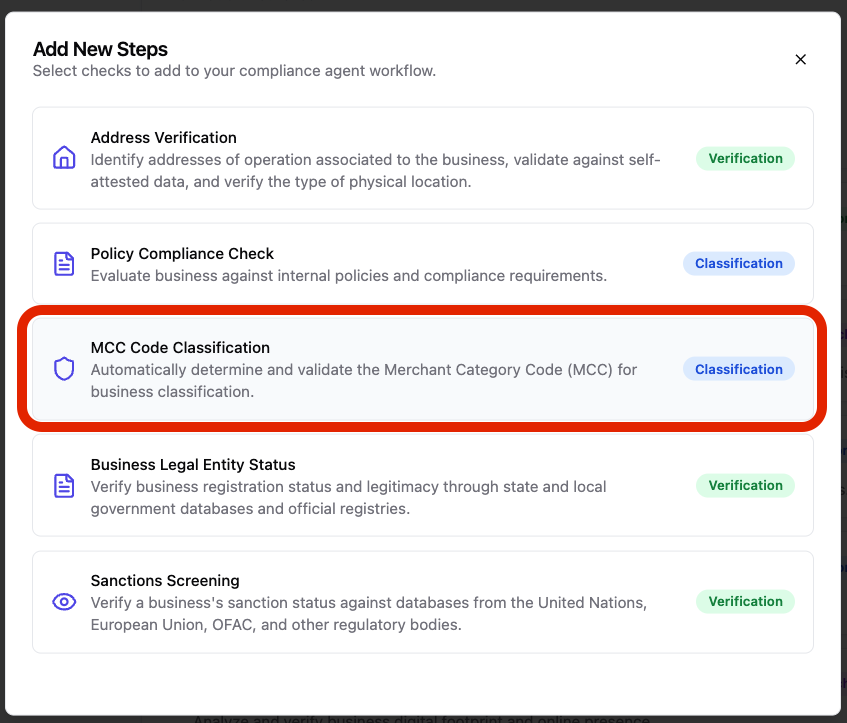
Navigate to your compliance agent configuration page
Click "Add another step" at the bottom of your verification workflow
Find "MCC Code Classification" in the available KYB checks
Click to add it to your due diligence process
Required Information
Before running this check, ensure your KYB case includes:
Business Name AND/OR Registered Business Name
Business Use Case Description (critical for accurate classification)
Website AND/OR Address of Operation AND/OR Address of Incorporation
Business Description (self-attested information)
Configuration Options
Basic Configuration
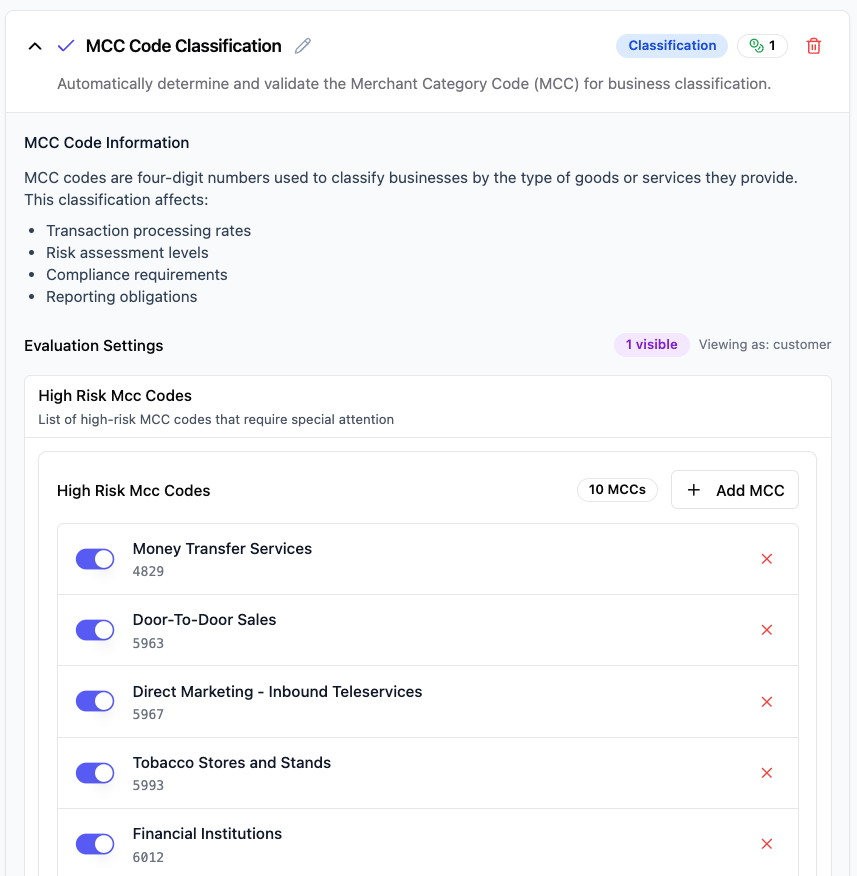
This check runs automatically with default settings, but you can customize several parameters to adjust the analysis scope and risk assessment requirements.
Risk Management Configuration
High-Risk MCC Codes: Define which MCC codes require special attention and enhanced monitoring
Default High-Risk Codes: Pre-configured list includes gambling (7995), escort services (7273), money transfer (4829), and securities trading (6211)
Custom High-Risk Codes: Add industry-specific high-risk MCCs based on your compliance requirements
Risk Alert Thresholds: Set parameters for when high-risk MCC assignments trigger additional review workflows
Industry Mapping Settings
Custom MCC Mappings: Configure specific MCC assignments for common business types in your portfolio
Software Development (recommended): Maps to MCC 7371 for custom programming services
IT Consulting: Maps to MCC 7379 for technical services
E-commerce Platforms: Maps to MCC 5734 for online software sales
SaaS Providers: Maps to MCC 7372 for prepackaged software services
Advanced Options
Custom Instructions Integration: Load specific Standard Operating Procedures (SOPs) for specialized MCC classification rules
Enhanced Analysis Depth: Increases web presence analysis thoroughness for complex business models (may increase processing time)
Screenshot placeholder: Advanced configuration options panel
Understanding Your Results
Check Status
✅ Passed: Successfully determined appropriate MCC code with high confidence based on business analysis
⚠ Review: MCC classification requires manual review due to insufficient data or conflicting information
❌ Failed: Unable to determine MCC code due to lack of verification data or inconclusive business information
Information Retrieved
When the check completes, you'll see:
Primary Classification Results
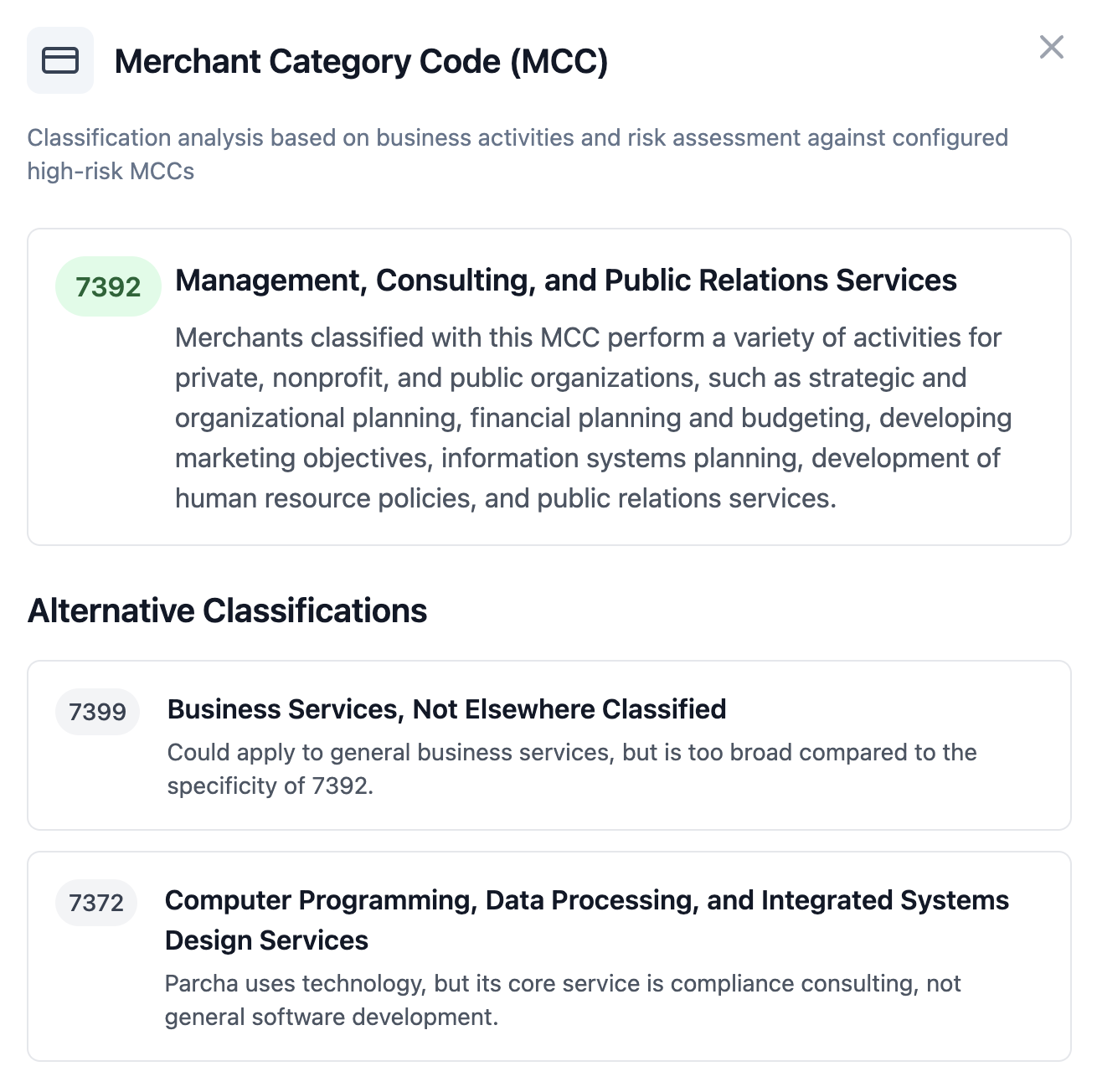
Assigned MCC Code: The 4-digit code representing the business's primary industry classification
MCC Code Title: Official description of the assigned merchant category
Classification Confidence: Indicator of how certain the analysis is about the MCC assignment
Business Activity Analysis: Summary of the core business operations that led to the MCC determination
Risk Level Assessment: Whether the assigned MCC is considered high-risk for compliance purposes
Screenshot placeholder: MCC Code Classification results panel showing primary classification
Alternative Classifications
The results panel shows:
Alternative MCC Options: Up to 4 additional MCC codes that could potentially apply to the business
Reasoning for Alternatives: Brief explanation of why each alternative MCC was considered
Self-Attested Comparison: Analysis of any discrepancies between determined MCC and self-reported business classification
Compliance Alerts: Notifications if the business falls into regulated or high-risk categories
Screenshot placeholder: Alternative classifications section in results panel
Common Issues and Solutions
❌ "Insufficient verification data for MCC classification"
Cause: The check cannot access enough business information from web presence or verification sources to make a confident MCC determination.
Solutions:
Ensure the business has an active, professional website with clear service descriptions
Verify that web presence analysis completed successfully before running MCC classification
Check that business use case description is detailed and specific about primary activities
Consider running additional business due diligence checks to gather more operational data
⚠ "MCC discrepancy detected between self-attested and determined codes"
Cause: The algorithmically determined MCC code differs from what the business self-reported during onboarding.
Solutions:
Review the business use case description to ensure it accurately reflects actual operations
Examine the detailed explanation provided for the MCC determination
Consider whether the business model has evolved since initial self-attestation
Document the discrepancy for compliance review if the difference is significant
Verify that self-attested information aligns with current business activities
❌ "High-risk MCC code requires enhanced due diligence"
Cause: The business has been classified with an MCC code that falls into regulated or high-risk categories.
Solutions:
Implement enhanced customer due diligence procedures per your compliance policies
Review additional documentation requirements for the specific high-risk category
Consider enhanced monitoring and reporting obligations for this merchant type
Ensure appropriate risk mitigation controls are in place for ongoing relationship management
Best Practices for Compliance Teams
Data Collection Standards
Ensure business use case descriptions are detailed and accurately reflect primary revenue-generating activities
Verify that web presence analysis has sufficient depth to capture all business operations
Collect supporting documentation that validates the determined MCC classification
Risk Assessment Guidelines
High-risk MCC codes (gambling, money services, adult entertainment) require enhanced monitoring and reporting
Financial services MCCs may trigger additional regulatory requirements and capital considerations
Technology/software MCCs should be validated against actual product offerings to prevent misclassification
Documentation Requirements
Maintain clear audit trails showing how MCC determinations were made
Document any discrepancies between self-attested and determined MCC codes
Ensure MCC assignments are reviewed and updated when business models evolve
Regulatory Compliance Context
This check supports your compliance obligations for:
AML (Anti-Money Laundering): MCC codes help identify transactions and businesses in high-risk categories that require enhanced monitoring under BSA/AML regulations. Certain MCCs (particularly financial services, money transmission, and gambling) trigger additional reporting requirements to FinCEN and mandate enhanced customer due diligence procedures.
KYB (Know Your Business): Accurate MCC classification is fundamental to proper customer risk assessment as required by federal banking regulations. The FFIEC guidance emphasizes the importance of understanding the true nature of business customers, and MCC codes provide a standardized framework for this classification.
Customer Due Diligence: MCC determination supports CDD requirements by ensuring businesses are properly classified according to their actual operations rather than self-reported information. This helps identify potential misrepresentation and ensures appropriate risk management controls are applied.
Enhanced Due Diligence: High-risk MCC codes automatically trigger EDD requirements under federal guidance. Businesses in gambling (7995), money services (4829), and other regulated industries require additional documentation, monitoring, and reporting procedures.
Regulatory References
Bank Secrecy Act (BSA): Requires financial institutions to monitor and report suspicious activities, with MCC codes helping identify high-risk transaction patterns
FinCEN Guidance: Provides specific requirements for monitoring money service businesses (MSBs) and other high-risk entity types identified through MCC classification
FFIEC Customer Due Diligence Guidelines: Emphasizes the importance of understanding customer business models and risk profiles through proper industry classification
Visa/Mastercard Compliance Programs: Card networks maintain MCC classification standards and require accurate merchant categorization for risk management
International Compliance
FATF Standards: The Financial Action Task Force recommends risk-based approaches to customer classification, with MCC codes supporting international AML compliance
Basel Committee Guidelines: International banking standards emphasize proper customer risk assessment, with industry classification as a key component
Cross-Border Considerations: MCC codes help identify businesses engaged in international activities that may require additional regulatory attention
Screenshot placeholder: Compliance documentation and audit trail features
Technical Details
Check ID: kyb.mcc_code_check_v3 Check Family: Classification Typical Processing Time: 2-5 minutes Data Sources: Web presence analysis, business verification data, official MCC code database
Need Help?
If you're experiencing issues with this check:
Review the troubleshooting section above
Check our Common Issues Guide
Contact our support team with your specific case details - we're here to help!
Last updated: January 9, 2025 Related checks: Web Presence Verification, High Risk Industries